When I first set foot in Hanoi's Old Quarter, I just stood at the entrance of an alley for fifteen minutes. I unfolded a map, but it was no help. The alley was too narrow, fast, and noisy. A motorcycle brushed past my shoulder, and I could hear the sound of metal being hammered from somewhere inside. From one direction, there was the smell of oil; from another, incense smoke. I wasn't sure if this was the 'Old Quarter' shown on the map.
Someone I don't remember said to me. Hanoi Old TownIt's not that you travel with your eyes, but with your ears.
I still remember those words even now, 10 years later.
Hanoi's Old Quarter and the 36 Streets (Phố Cổ Hà Nội) are not merely old alleys. Each street dealt in different goods, and the sounds those goods emitted were distinct; people gathered there drawn by those sounds. That principle remains alive to this day. Walking along with this knowledge reveals a completely different landscape.
Hanoi Old Quarter: If You Understand the Principles of the 36 Streets, You Can Read the Alleys
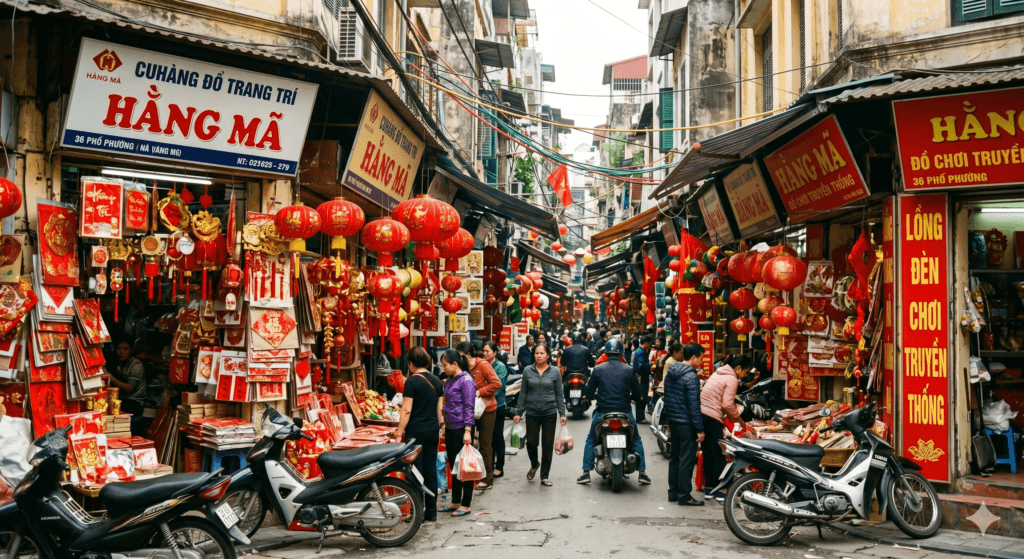
The name of Hanoi's Old Quarter, 'Phố Cổ,' means "old street." The reason it is called the "36 Streets" stems from the past guild system. Merchants dealing in specific professions or goods lived together on each street, and the street names originated from those goods.
Hang Ngân (Silver Street), Hang Dong (Copper Street), Hang Gai (Hemp and Silk Street). Traces of these names still remain today. Although not exactly the same, the tendency for similar businesses to cluster together is still valid.
If you understand this principle, you can find your way without a map. If you hear the sound of metal being hammered, you are near Hang Dong; if there are rows of fabric shops, you are heading toward Hang Gai; and if you see shops selling red paper and ritual supplies, you are toward Hang Ma. The distinct sounds and smells of each street serve as a substitute for a map.
- Hangma (Hàng Mã): Colored paper, decorations, ritual supplies — the entire alley is red
- Hangai: Silk, Clothing, Embroidery — Tourist Shopping Center
- Hangdong (Hàng Đồng): Brass and copper products — the sound of hammering can be heard
- Hang Bu Om: Snacks and dried foods — sweet and salty smell
- Inside the Anti-Magic Alley: Household goods like a permanent market, high proportion of locals
Vietnam Tourism Authorityvietnam.travelIt introduces Hanoi's Old Quarter as a living heritage of traditional Vietnamese commercial culture. However, to truly experience that heritage, you must walk it on foot rather than rely on signboards.
How to listen to sounds in an alley
The first thing that overwhelms a first-time walker in the Old Town is the visual spectacle. There are countless signs, crowds of people, and motorcycles. Consequently, everyone tries to navigate using their eyes. They hold up their smartphones to check the route, take photos of landmarks, and move on to the next location.
However, the true texture of the Old Town lies in the sound. At 6 a.m., just as the sounds of street sweeping fade, the sound of boiling rice noodle broth begins. When metal workshops open, there is the sound of hammers. When fabric shops open, there is the soft sound of cloth unraveling. By the afternoon, the sounds of tourists haggling mingle with the sounds of local children running around.
Every sound has a time of day, and every time of day has a different street expression. The Old Town from 7 to 9 AM is local time.It is. You must walk at this time to encounter scenes not found on maps. Elderly people eating breakfast on plastic chairs in front of a pho shop, shop owners cleaning with their shutters still half-closed, and a father riding a motorcycle with his child heading to school.
After 10 a.m., the atmosphere of the streets changes as tourists begin to flock in. How you spend the two hours before that is half the experience of exploring the Old Town.
Alleys you encounter when you turn off the map
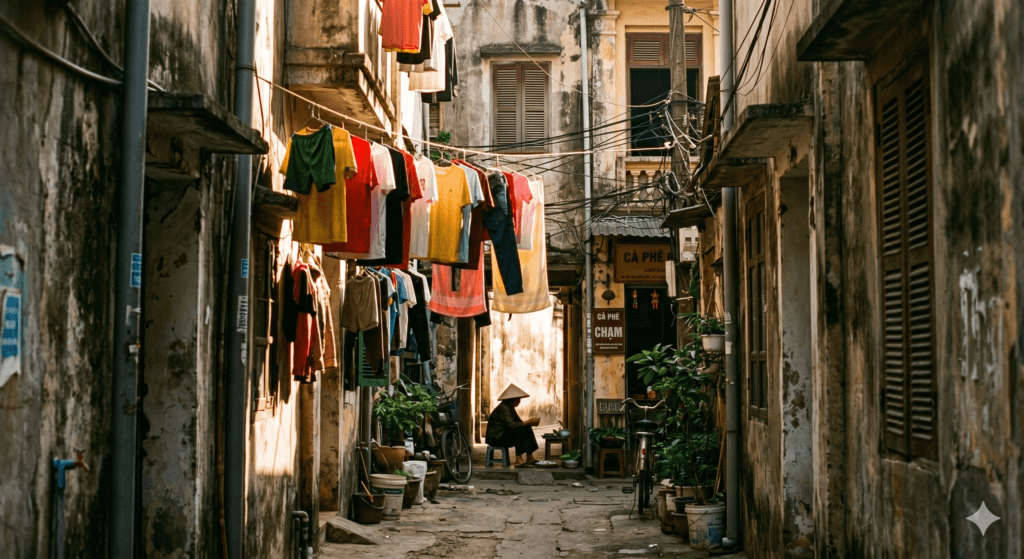
If you walk around with a smartphone map turned on, you end up following the routes of tourists. The 'attractions' guided by algorithms are already packed with the same travelers. The more accurate the coordinates, the less Hanoi itself is visible.
If you walk with the map off, you will get lost. And that is true. The Old Town is intricately interwoven like a web, so no matter which direction you walk, you eventually come out onto a main street. Hoan Kiem Lake serves as the southern reference point, so you just need to follow the people heading in that direction. The alleys you encounter along the way are the real ones.
I have discovered something while guiding people for a long time. The traveler who gets lost for the first time remembers more. Whether it was taking shelter from a sudden rain under the eaves of a house, drinking egg coffee for the first time at a small café at the end of an alley, or hearing the sound of children's laughter coming from a house with a door half-open. These are things that maps do not tell you.
The old town is a process, not a destination. What you hear in this alley right now is more important than where you came from or where you are going.
If these alleys start to feel similar to one another while you're walking alone, try walking with a local just once. An alley seen through familiar eyes will feel different even if you visit alone the next time. Please contact us via KakaoTalk..
Three criteria for finding local cafes and pho restaurants
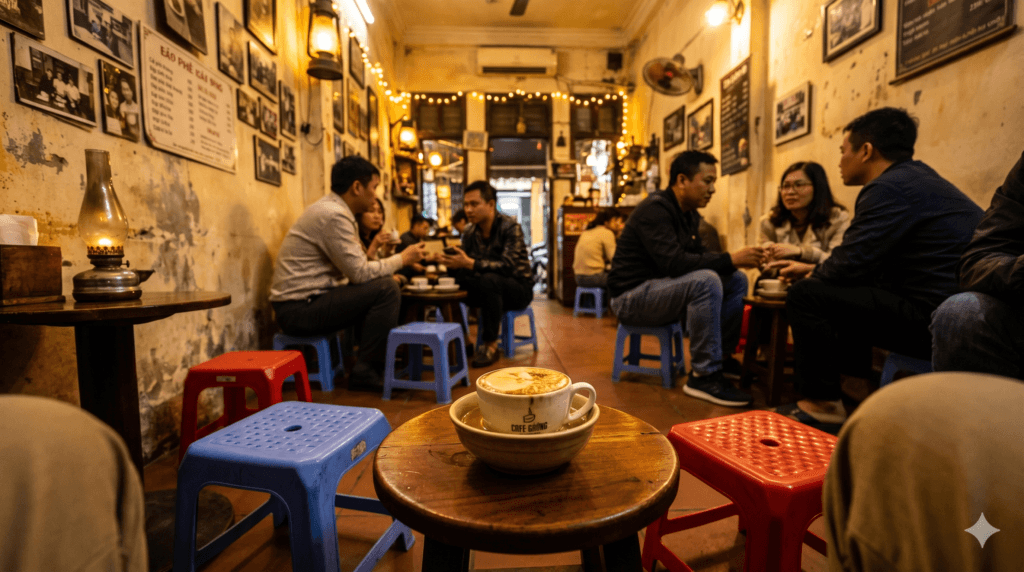
Restaurants listed in tourist guidebooks are already double the price. Finding places where locals go is not complicated.
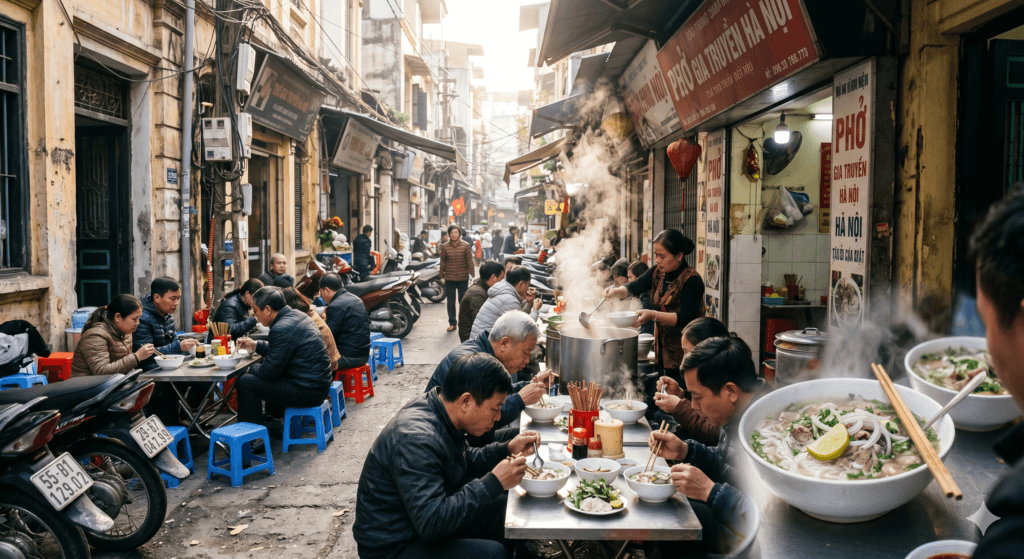
First, places that are open before 7 AM. Local restaurants open early in the morning. Places selling pho or bun cha are already packed with customers by 6 or 7 a.m. and close by 10 a.m. If the door is already closed, it means they have finished business for the day.
Second, a place with low, small plastic chairs. A house in India with rows of low plastic chairs is a local restaurant. If the tables are wooden and the menu is in English, it targets tourists. The more uncomfortable the chairs are, the higher the chance it is authentic.
Third, places with two or fewer menu items. A truly good restaurant specializes in just one thing. A place that sells only Bun Cha, or only Pho. The more extensive the menu, the more touristy the place becomes.
Egg coffee (Cà phê trứng) can be easily found at cafes around Hang Gai Street. However, the nameless cafes tucked away in the adjacent alleys are often tastier than the famous shops. Places with no lines, uncomfortable chairs, and no menus—those are the local cafes.
If you are planning a trip to Northern Vietnam for the first time, it is a good idea to check information about regions other than Hanoi in advance. Complete Guide to Traveling in Northern VietnamYou can refer to the entire itinerary from Hanoi to Sapa and Ha Long Bay.
Getting lost is the beginning of the journey
Hanoi's Old Quarter is easy to read. If you walk slowly and listen to the sounds, you get a sense of which street you are on. If you use Hoan Kiem Lake as your reference point, no matter where you walk, you are bound to eventually return.
If you are afraid to turn off the map, just try it for 30 minutes. Enter the most chaotic-looking alley, listen to the sounds, smell the smells, and walk while observing what you see. If you see Hoan Kiem Lake after 30 minutes, you have succeeded. The scenes you encounter during that process are what make you remember Hanoi.
If you are planning a trip to Northern Vietnam leading to Sapa or Ha Long Bay, Complete Guide to Sapa TravelIt is also helpful to read this. The itinerary starting from Hanoi and leading to Sapa fits particularly well at this time of year, in late April.
If you are looking for a walking tour of Hanoi's Old Quarter, please contact us directly. We operate small-group tours that follow the locals' routes and times, rather than standard tourist itineraries. From morning pho and alley cafes to workshops not found on maps—once you walk the whole thing properly, you'll be able to explore on your own the next time.
In the next episode, we will cover Hoan Kiem Lake. Rather than viewing it as a tourist attraction, we will capture, from a local perspective, why Hanoi citizens come out there at 5 a.m., how the legend of the turtle still lives on, and how the alleys around the lake transform throughout the day.
I reside in Ha Long Bay and simultaneously work as a tour guide, operate a travel agency, and make local investments. For private tour consultations and travel inquiries, please refer to the ' in the top menu‘Tour Inquiry‘Please use '.