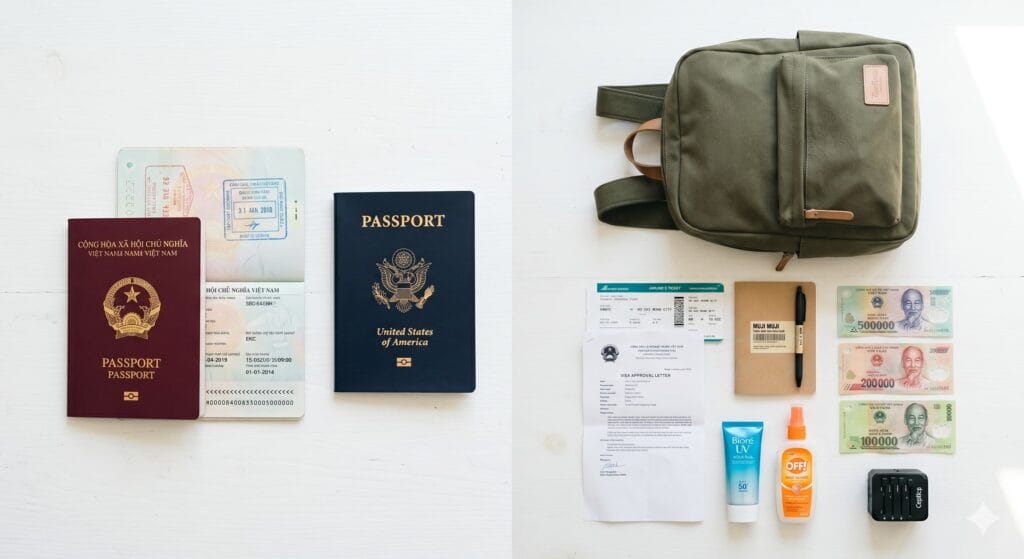
The night before departure, I spread my bag out on the living room floor and start packing when my hands stop. “Did I pack the adapter?” “Where did I put the first aid kit?” On a package tour, a guide would double-check everything for you, but on a private trip, no one takes care of it for you. This is why the words “I should have brought this” only come out after arriving at the airport.
Living in Vietnam for 10 years, I personally welcomed hundreds of Korean travelers. Among them, the phrase I heard most frequently was exactly that. Some people forgot their sunscreen and got sunburned on their first day, while others left their multi-adapters behind and couldn't charge their phones on the first night. One or two seemingly trivial details determine the first impression of a trip.
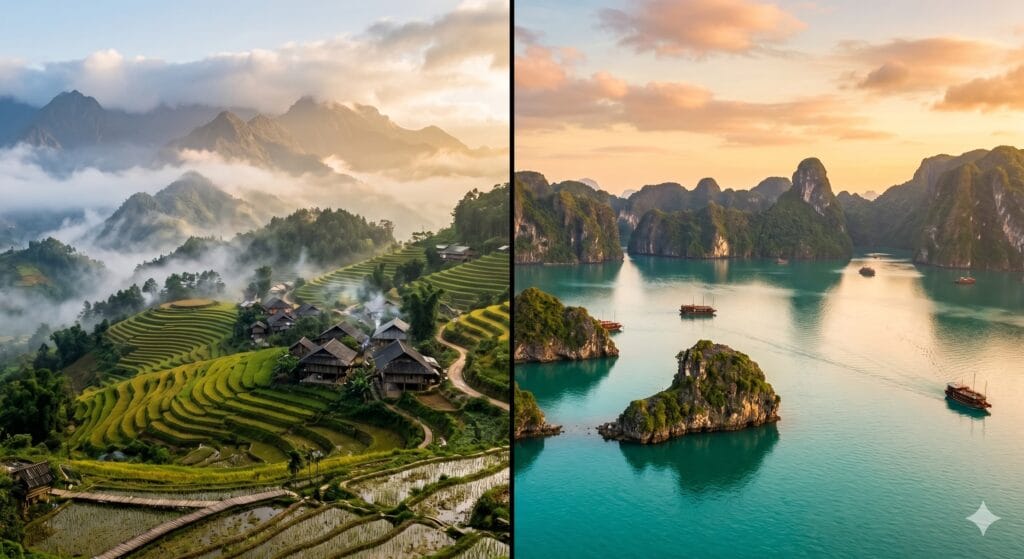
Therefore, this article is not merely a packing list. It is a checklist of essentials for a trip to Vietnam, carefully selected and organized to include only the absolute necessities for Korean travelers actually visiting the four northern regions of Vietnam: Sapa, Ha Long Bay, Ninh Binh, and Hanoi. For each item, I have included "why it is necessary" based on my on-site experience.
Vietnam Travel Packing Checklist — From Essential Documents
First up are the documents. While you can purchase all other luggage locally, you cannot for documents. There are five key items: a passport (valid for at least six months), a visa (45-day visa-free entry for Koreans; prior issuance of an e-visa is required for extended stays), a flight reservation confirmation, a hotel reservation confirmation, and travel insurance.
A passport with a validity period of only six months is not merely a recommendation but grounds for refusal of entry. In some cases, it is even screened out at the airline counter when departing Korea. If you check it about four weeks before departure, your renewal schedule will not be tight.
The 45-day visa-free period counts from the day of entry. If you enter on May 1, your legal stay lasts until midnight on June 14. If you exceed this by even a single day, you will be fined by immigration at the airport upon departure, and a mark will remain during future immigration screenings. The most unfortunate case I witnessed firsthand was when a passenger whose departure was delayed by one day due to a schedule change paid a fine of approximately $25 on the spot at the airport.
Accommodation reservation confirmations can be an unexpected variable. While they are not required for all travelers during Vietnamese immigration checks, solo travelers or those without long-term visas are often asked to show a paper copy or a PDF screen. It is convenient to take a screenshot of your Booking or Agoda confirmation email in advance.
Travel insurance is optional, but it is strongly recommended in Northern Vietnam. If you sprain your ankle while trekking in Sapa or develop gastroenteritis on a Ha Long Bay cruise, local medical expenses can accumulate surprisingly quickly. The key is not just signing up, but saving the insurance certificate PDF on your phone.
Clothes You Actually Need for a Trip to Northern Vietnam
Northern Vietnam is the region with the most unpredictable climate. Since temperatures in the Sapa mountainous region and downtown Hanoi can differ by more than 10 degrees on the same day, you will inevitably regret packing with a single type of clothing.
Sapa is the place where Korean travelers most frequently pack the wrong clothes. The average minimum temperature in Sapa in January is about 2°C, and there are days when it drops close to 0°C at dawn. Every year, I have seen guests who packed only summer clothes buying thick outerwear at local markets. If you have included Sapa in your itinerary from January to early March, outerwear suitable for late autumn in Korea is essential.
A Ha Long Bay cruise is another variable. The wind on the deck is stronger than expected, so a light windbreaker is necessary even in spring or autumn. If you plan to stay on the deck for an extended period during sunrise and sunset, a light scarf or hat will also be helpful.
During the rainy season from May to October, a poncho is recommended over a folding umbrella. You need both hands free to carry your luggage and camera simultaneously when a sudden downpour occurs. The more outdoor activities you have, such as the boat trip to Trang An in Ninh Binh or trekking in Sapa, the greater the value of a raincoat becomes.
Money and Payments — Cash or Card?
Northern Vietnam remains a cash-centric society. While the number of cafes and restaurants in downtown Hanoi accepting card payments has increased, the situation is quite different just a short distance outside the city center. Tips for Ha Long Bay cruises, shopping at Sapa markets, and motorbike rentals in Ninh Binh—almost everything accepts only cash.
It is much more advantageous to exchange small amounts of Vietnamese Dong (VND) locally. Airport exchange offices are places where you buy convenience immediately after arriving, whereas exchange offices in the city (especially gold and silver shops in Hanoi's Old Quarter) offer better exchange rates of 1 to 21 TP3T. I recommend exchanging only about 50 dollars at the airport to cover transportation costs within the city, and exchanging the rest all at once in the city.
One point Korean travelers often overlook here is the customs declaration standard. The obligation to declare arises the moment the amount exceeds US$5,000 or 15 million VND, and starting July 2026, the penalty for failure to declare upon departure will increase to a maximum of 50 million VND (approximately 2.7 million KRW). For detailed declaration procedures and the new enforcement decree, How to fill out a Vietnam customs declaration formI organized it separately.
Cards are a supplementary means. Visa and Mastercard are accepted at hotels, mid-range or higher-end restaurants, and some department stores, but they are practically useless for cave entrance fees, market food, and local cafes. If you have a local SIM card, Vietnamese QR payment (VietQR) may work at some shops, but usage is restricted if you do not have a foreign account.
If you have any questions about the itinerary or packing for a trip to Northern Vietnam, feel free to ask a guide who has lived there for 10 years.
👉 Contact via KakaoTalk Channel
Health and Safety Supplies
It is overwhelmingly more convenient to stock up on over-the-counter medicines in Korea. Although there are many pharmacies in Vietnam, English-speaking pharmacists are rare, and many general medicines differ in ingredients and labeling from those in Korea. If you bring just three types of medicine—anti-diarrheal, digestive aids, and painkillers—you will be free from the variables of the first 24 hours.
Mosquito repellent is especially important for the Sapa trekking and Ninh Binh itinerary. In the terraced rice fields of Sapa and along the rivers of Ninh Binh, there are mosquitoes of a size rarely seen in Korea. It is reassuring to bring a can of a familiar Korean brand. The same applies to sunscreen. Due to the lower latitude, it is common for the UV index to be measured one level higher than in Korea.
Water is the simplest thing, yet the most important. Tap water in Northern Vietnam is not purified to the same standard as in Korea. Even I, having lived here for 10 years, brush my teeth with tap water but always drink bottled water. If hotel rooms provide two bottles of water daily, it is safer to stock up on extras at a convenience store if your travel route is long.
Things you often miss — things you're too late to buy locally
A few small items determine the satisfaction of the first day of the trip. I will organize them in order of frequency of personal observation.
A multi-adapter is the top priority. Vietnamese electrical outlets use a mix of Type A (American flat) and Type C (European round) plugs. The types vary by hotel room, and even within the same room, the outlets next to the bed may differ from those on the desk. If you only bring a Korean adapter, you will be stuck charging your phone on the very first night. A single multi-adapter covers almost every situation.
Portable power banks are no pushovers. Ha Long Bay cruises, in particular, have limited power outlets in the cabins and almost none on the deck. To comfortably take photos of the sunrise and sunset, a power bank with a capacity of 10,000mAh or more is practically essential. Don't forget to check the carry-on limits for airplanes (160Wh or less) in advance.
A copy of your passport can be surprisingly useful on the go. Some accommodations keep your passport for safekeeping upon check-in, and in some cases, you are required to leave it as a security for identification when renting a motorcycle. It is safer to leave your original passport in the hotel safe and carry a copy.
Finally, note down emergency contacts. Writing down the Consular Call Center of the Embassy of the Republic of Korea in Vietnam, the lost card reporting number for your Korean credit card company, and your insurance company's emergency line on a piece of paper and keeping it in your wallet is crucial in the event of phone loss. The more dependent you are on digital technology, the more reassuring a single piece of paper feels.
Organizing — Not a packing list, but peace of mind
The better prepared a traveler is, the deeper the experience they have on location. If the first day of your itinerary is shaken by a lack of a single multi-adapter or power bank, the fog of Sapa and the karst of Ha Long Bay that you encounter later will be obscured by half. Filling out your packing list is ultimately a process of securing peace of mind. I hope you will use this Vietnam travel checklist as your starting point.
Recommended articles to read together:
– How to Fill Out a Vietnam Customs Declaration Form — Penalties for Undeclared Cash Change Starting July
– Northern Vietnam Travel Guide — Sapa · Ha Long Bay · Hanoi · Ninh Binh
Official Reference: Ministry of Foreign Affairs Safe Travel Abroad — Vietnam
If you need a personalized itinerary rather than a package tour, we recommend consulting with us before packing.
👉 Inquire about private tours
The author resides in Ha Long Bay and works as a tour guide, operates a travel agency, and engages in local investment. For private tour consultations and travel inquiries, please use the 'Tour Inquiry' option in the top menu.