One hour by bus from Lao Cai.
As you climb the winding mountain road, at some point, fog begins to cover the windows. The village spread out below the road disappears, and something resembling white smoke drifts in through the dense trees. People who first think of Sapa trekking usually picture terraced rice fields in their minds, but what they encounter first is this fog.
When the bus door opens, cold air rushes in first. 1,500 meters above sea level. It takes a moment for my body, accustomed to living in Ha Long Bay, to accept this chill. While tourists zip up their jackets and the guide is already on the phone, I simply breathe in the air.
Even before the Sapa trekking begins, I feel that something has already changed.
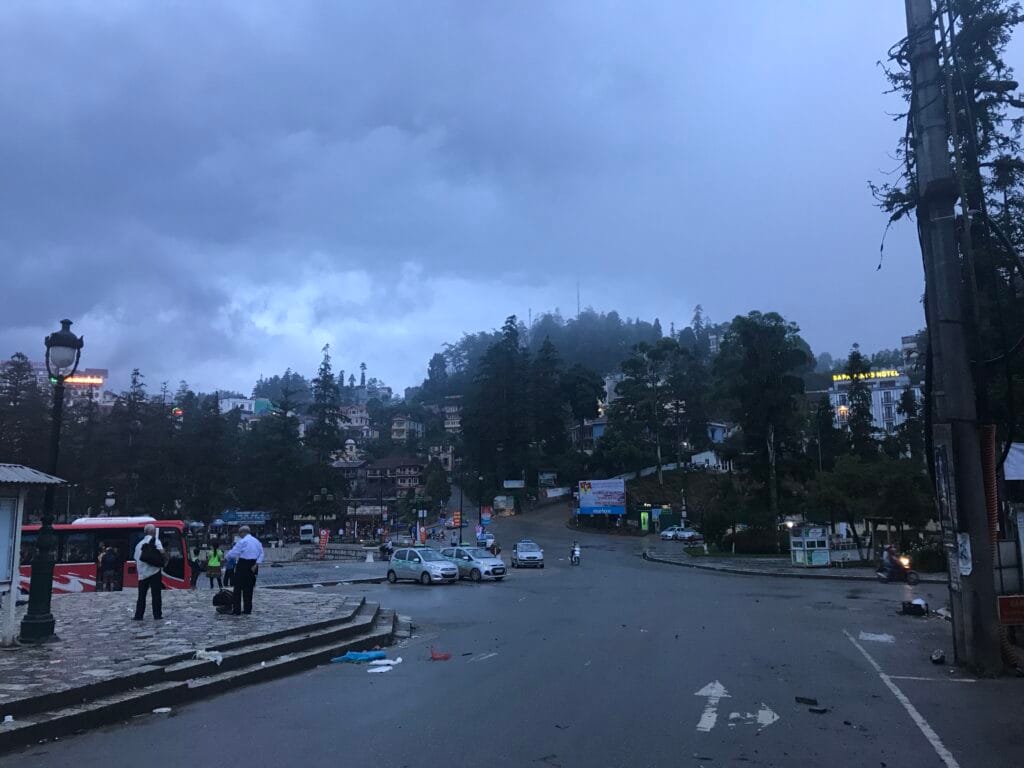
The reason I don't stop at the city center square
The central street, lined with hotels and souvenir shops around Sapa Church, is smaller than expected.
First-time travelers take photos at this square, have a cup of coffee, and take proof that they have arrived in Sapa. I did the same at first. However, the more time I spent in Sapa, the more I realized that this square is merely the starting point, not Sapa itself.
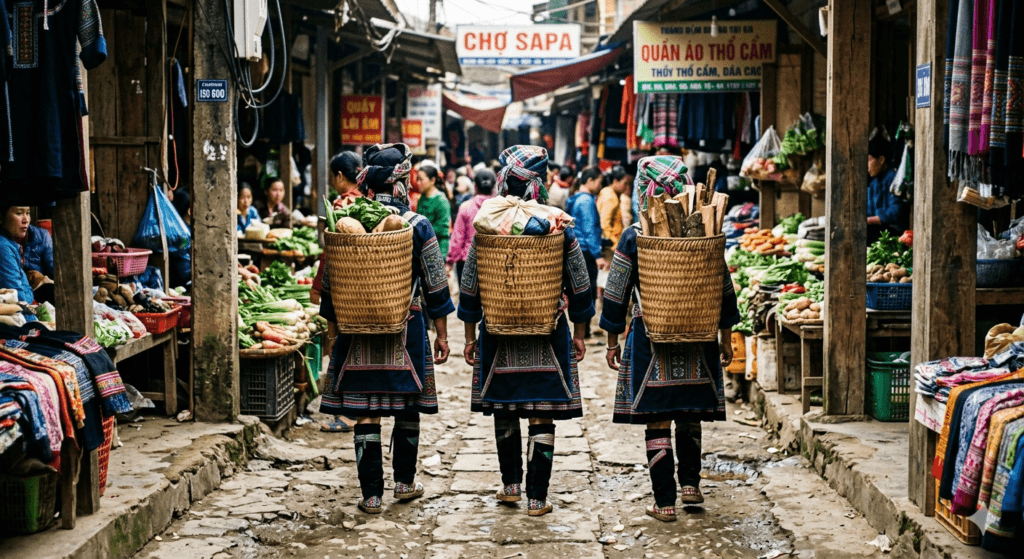
The scenery changes the moment you step just one alleyway away from the square. Hmong women walking with their loads on their backs, the smell of grilling meat rising from narrow market alleys, and children running around after school. While the city center of Sapa is styled like a stage for tourists, real life begins just one alley away.
Sapa trekking is walking into that life.
Sapa Trekking: The World Changes Depending on the Route
There are three main directions for the Sapa trekking routes.
The road leading down to Tả Van village, the road passing through Lao Chải village, and the road leading to Cát Cát village. Depending on which direction you choose, the scenery and the people you meet are completely different.
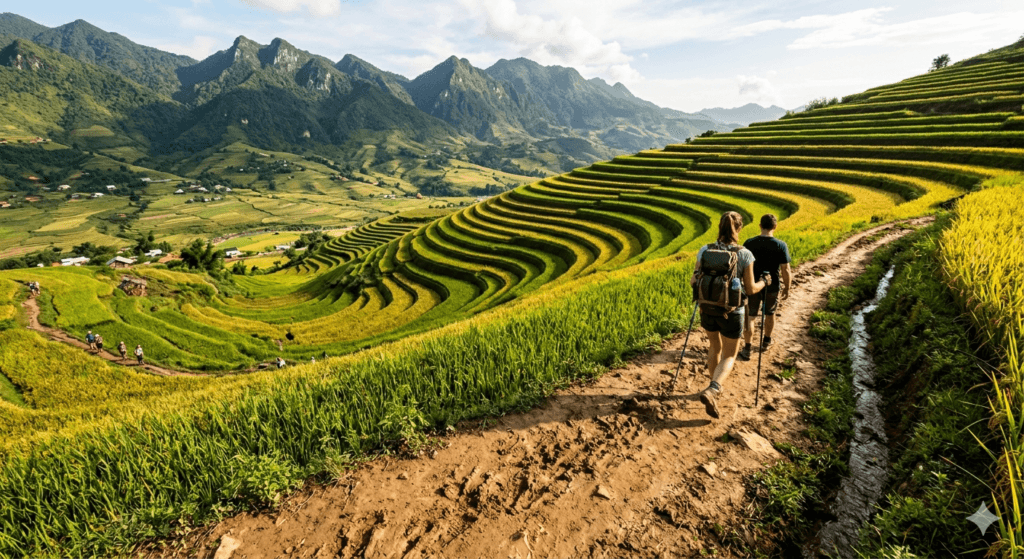
On the day I first set out on a trek in Sapa, the path I was guided to was in the direction of Ta Van. It was a route that involved slowly descending along a narrow dirt path winding through terraced rice fields. After walking for about three hours, the Mường Hoa Stream comes into view, and if you follow the river back up, you reach a Black Hmong village.
On that road, I spoke with a Hmong woman for the first time. Next to her, as she asked in Korean, “Where are you from?”, was a basket full of handmade fabric. I wondered if she wanted me to buy something, but as I listened carefully, I realized she simply wanted to talk.
You see as much as you know, and you stay as long as you see.
Why it is difficult to trek in Sapa alone
There is no guarantee that you won't get lost just by keeping the map app on.
The weather in Sapa is difficult to predict. It is common for the sky to be clear in the morning to turn into thick fog by lunchtime, and the dirt roads are slippery during the rainy season. There are also many sections where the road markings are unclear. Once, a traveler who set out alone got lost in a village and did not return until sunset.
There is something even more important than that.
Even when walking the same path, what you see is different. Whether or not you can hear the stories behind which people spent hundreds of years creating those terraced rice fields, the meaning of the red cloth hanging from the window of that house, and what is hanging from the tree at the entrance of the village—this is what determines the depth of the journey.
If it is your first time trekking in Sapa, it is better to go with someone you know rather than alone.
👉 Inquire about Sapa Trekking Private Tours
A guide who has lived here for 10 years will personally lead the tour. We will walk together along routes not shown in group packages.
The meaning of taking a step
On the way back to the accommodation after the trek, my legs are aching.
But strangely, I feel good. It’s not because I exercised. It’s because I saw something with my own eyes. Because I didn’t just see it with my eyes, but saw it directly on that dirt road by walking with my body and stepping on it with my feet.
There is something that every traveler returning from the Sapa trekking says in unison: “It was much better than I expected.” I now know where that difference of ‘better than expected” comes from.
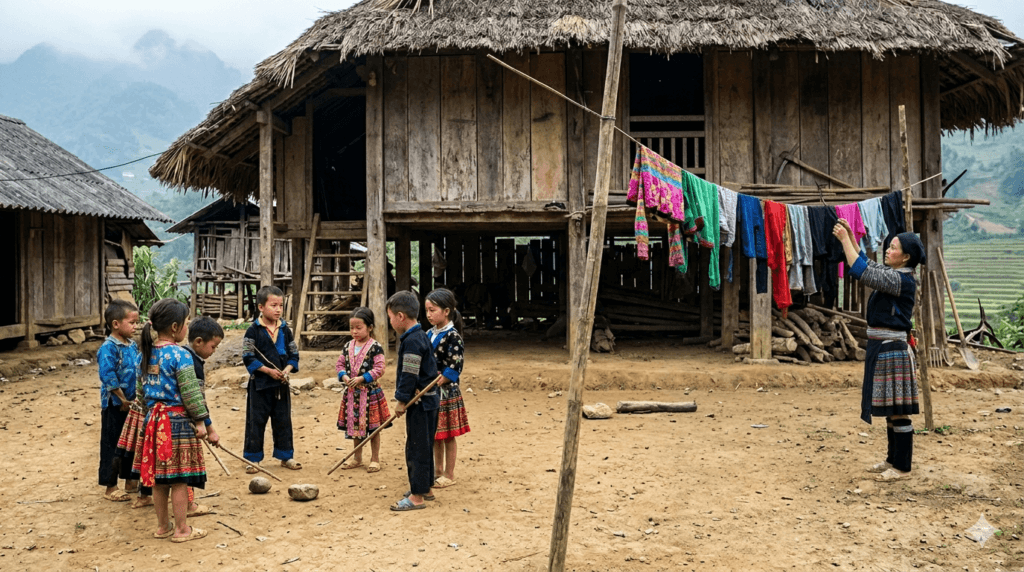
Setting foot in Sapa does not simply mean arriving somewhere. It means taking small steps into the life that has continued for hundreds of years on these mountains.
(Sapa Series Part 1 — Sapa Trip: Between “Have Been There” and “Have Experienced”We discussed this difference in more detail at.)
If you want to personally experience Sapa trekking routes that are not shown in packages,
👉 Consult on private tours with local guides
A person who has walked this path for 10 years is with us.
Next episode preview
In the next episode, we finally get on the board. What did I see and feel in Fansipan, the roof of Indochina…
The author resides in Ha Long Bay and works as a tour guide, operates a travel agency, and engages in local investment.
For private tour consultations and travel inquiries, please use the '‘Tour Inquiry’Please use .