In a corner of the Sapa market, women of the Red Dao people, the true owners of Sapa, were sitting together. Among the Hmong women dressed in indigo, one person in particular caught my eye. She wore a crimson cloth headscarf, and her collar was adorned with intricate hand-stitched embroidery. Her hair was shaved above her forehead, and her eyebrows were clearly defined. I remember being speechless for a while after seeing that woman when I first arrived in Sapa.
It was only later that I learned that the red headscarf was the mark of the Red Dao people. The Red Dao. In Vietnam, they are called 'Dao Đỏ,' the Red Dao people. From their clothes to their headscarves, red is their identity. Although I have encountered them countless times while living in Sapa for over ten years, the more I get to know them, the less I realize they are.
To understand the Red Dao people, one must first accept a fact: they do not live in Sapa; rather, Sapa came into being on their land. The Red Dao are the people who have cultivated fields, gathered medicinal herbs, and wove cloth on these mountain slopes long before the area became known as a tourist destination.
How to recognize the Red Dao tribe for the first time
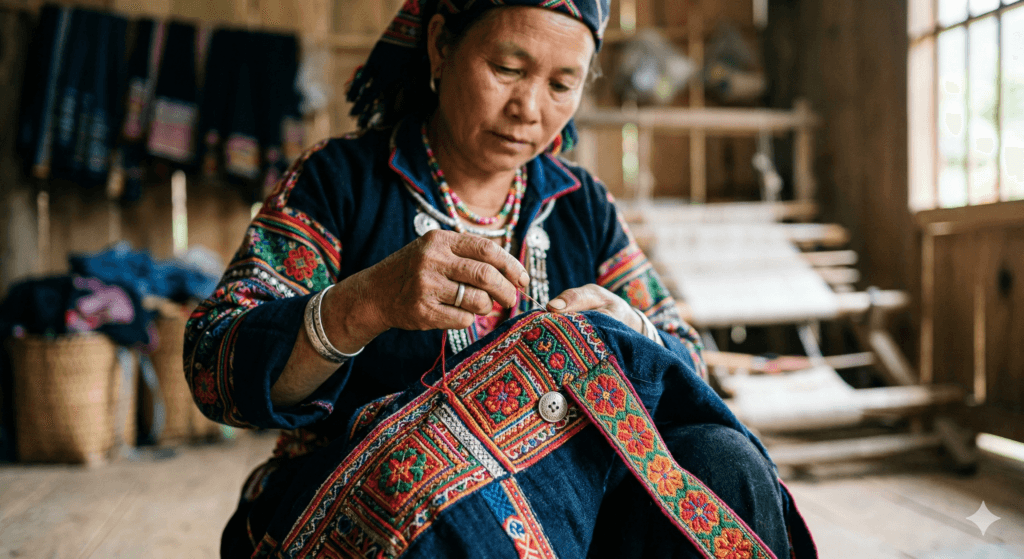
Since various ethnic minorities live together in Sapa, it is difficult for first-time travelers to distinguish who belongs to which ethnic group. The Red Dao people, however, are relatively easy to recognize.
The first thing that catches the eye is the headscarf. Large, round crimson cloth headscarves—while the way they cover the forehead or are tied high varies slightly from village to village, the color red remains constant. The clothing is mostly black with dense red and white embroidery. Every detail, from the way the front is fastened to the patterns on the sleeve cuffs, embodies the village's traditions.
Another custom is the forehead. Red Dao women traditionally shave their foreheads and trim their eyebrows. While modernized young women may not follow this custom, it remains a standard of natural beauty for older women. Although it may appear unfamiliar to those seeing it for the first time, it is interesting that this standard has been maintained for hundreds of years.
Herbal Decoction — A Tradition the Body Remembers
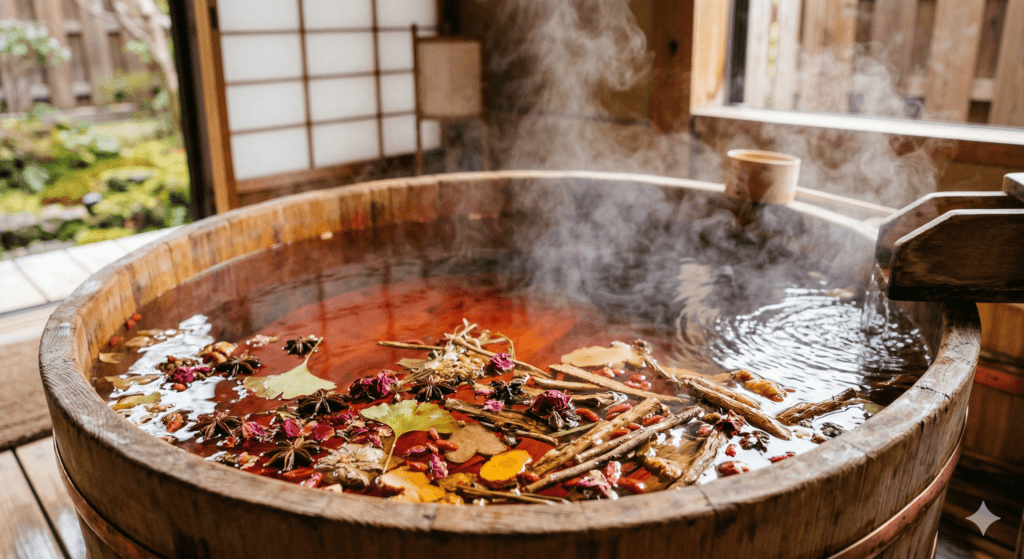
You cannot leave out the herbal bath when talking about the Red Dao people. It is also the most sought-after Red Dao cultural experience for travelers in Sapa.
Their herbal baths are not just simple spa treatments. They boil herbs directly harvested from the mountains according to recipes passed down through generations. Some villages use twelve different herbs, while others blend far more. Improved blood circulation, fatigue recovery, and muscle relaxation after hiking—in fact, many guests who have finished trekking in Sapa say that their legs feel "revived" after taking a bath.
When I first visited a Red Dao family, an elderly woman was preparing bundles of medicinal herbs in a corner of the yard. I asked for the names of the herbs, but I only knew the local names and had no way to translate them into Korean. That was actually more impressive. The fact that centuries-old knowledge is passed down without documents, solely through memory and hands.
If you are interested in an itinerary that includes a visit to a Sapa Red Dao family home or a medicinal herbal bath experience, please ask first. As a local guide, I can assist you with visits connected to actual families, rather than commercial establishments. Contact via Kakao Channel
Red Dao Tribe Embroidery — What Is Sold and What Is Left Behind
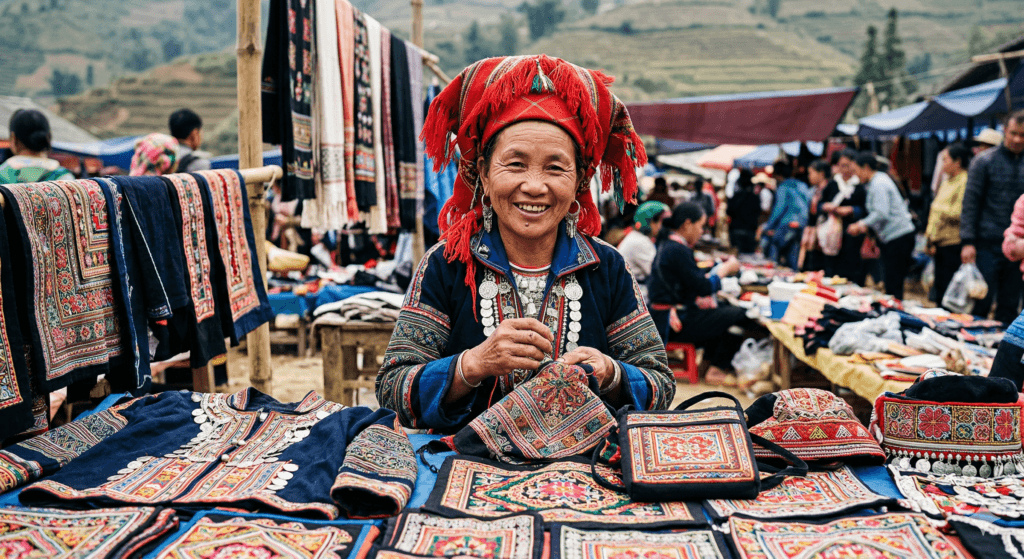
If you visit the Sapa market, you will find it overflowing with embroidered goods made by Red Dao women. Bags, pouches, bracelets, and wall hangings. Many tourists purchase these items, and it is true that the profits help support their families.
However, there is something I have learned over the past ten years: there is a difference between what is sold and what is kept at home. Most embroidered items sold in the market feature simplified patterns tailored to tourist demand. The colors are more vibrant, and the stitching is faster to keep costs down. But the embroidery a mother places on her daughter's dowry at home is different. It is the result of months of painstaking effort, faithful to traditional patterns, and uses colors strictly according to the principles.
One day in Red Dao Village, an old man took out an old coat and showed it to me. He said it was decades old. The fabric was worn, but the embroidery was still intact. The words, “I don’t sell this,” lingered in my mind for a long time that day. In an era where everything can be sold, possessing something that is not for sale—that felt like his final boundary.
Please read the previous post first for a general overview of the ethnic minorities in Sapa.
The place where the Red Dao people stand amidst tourism

As Sapa became famous, the lives of the Red Dao people changed significantly. Children attend school, use smartphones, and learn English. Young women haggling in the market know a few Korean words.
Change is not a bad thing. Many families have seen their living standards improve as tourism revenue flows in. However, looking back over the past decade, there is one question I do not want to overlook: Was this change a choice they made, or did it stem from a structural situation where it was inevitable?.
If you venture deep into the Red Dao villages, there are places untouched by tourism. In such villages, grandmothers still work in the fields wearing headscarves, children speak in the Red Dao language in the yards, and the scent of boiling medicinal herbs fills the air in the evening. I do not know how long those scenes will remain, but they are still there now.
The best way to meet the Red Dao tribe

It is not difficult to take photos with Red Dao women in downtown Sapa. However, that does not mean you have met the Red Dao people.
To get a closer look at the lives of the Red Dao people, you must enter the villages. The villages of Ta Van, Ta Phin, and Van Po are where the Red Dao mainly live. Although it is only 20 to 40 minutes from downtown Sapa, if you go without a local guide, you will most likely end up standing awkwardly in front of a house and returning. The villagers also do not show a welcoming expression toward unfamiliar visitors.
It is different when you have a direct connection to a family. Having a cup of tea, watching embroidery work, and experiencing a medicinal herbal bath at home—those moments become the most memorable scenes from Sapa. I have taken hundreds of guests to that village, and they all say the same thing upon their return: “This is my first time experiencing something like this.”
If you are planning a Sapa itinerary that includes a visit to Red Dao Village, I can personally guide you. This is a visit connected with an actual family, not a commercial experience program. Contact via Kakao Channel
Next episode preview
In the next installment, I plan to talk about the Hmong, another ethnic minority in Sapa. If the Red Dao are red, the Hmong are indigo. I will discuss the differences between these two peoples who, despite living in the same mountains, approach the world in completely different ways.
I reside in Ha Long Bay and simultaneously work as a tour guide, operate a travel agency, and make local investments. For private tour consultations and travel inquiries, please refer to the ' in the top menu‘Tour Inquiry‘Please use '.