It was the first time I opened the menu at a restaurant in Ha Long Bay. Below the column listing beer, soju, and bottled water, I saw two unfamiliar characters. Wine. And not just any wine, but Vietnamese wine. Pointing at it with my finger, I asked the waiter, “Is this real wine?” The waiter smiled and nodded. I ordered that wine that evening, and as I raised my glass, I wondered: Is it even possible for this country to have vineyards?.
A tropical country, a land with an average annual temperature exceeding 25 degrees, and a seasonal structure divided into dry and rainy seasons. It seems far removed from the optimal grape-growing regions described in wine textbooks. Yet, there are wineries in Vietnam. And not just any wineries, but ones that have won gold medals at international competitions. How is this possible? Tracing the history of Vietnamese wine reveals how this nation has strived to overcome the limitations of its climate.
If you are traveling to Vietnam for the first time, you will likely come across this question on a restaurant menu at least once: Vietnamese wine. Reserve your judgment and give it a try. That glass holds a longer story than you might expect.
What France planted in Da Lat
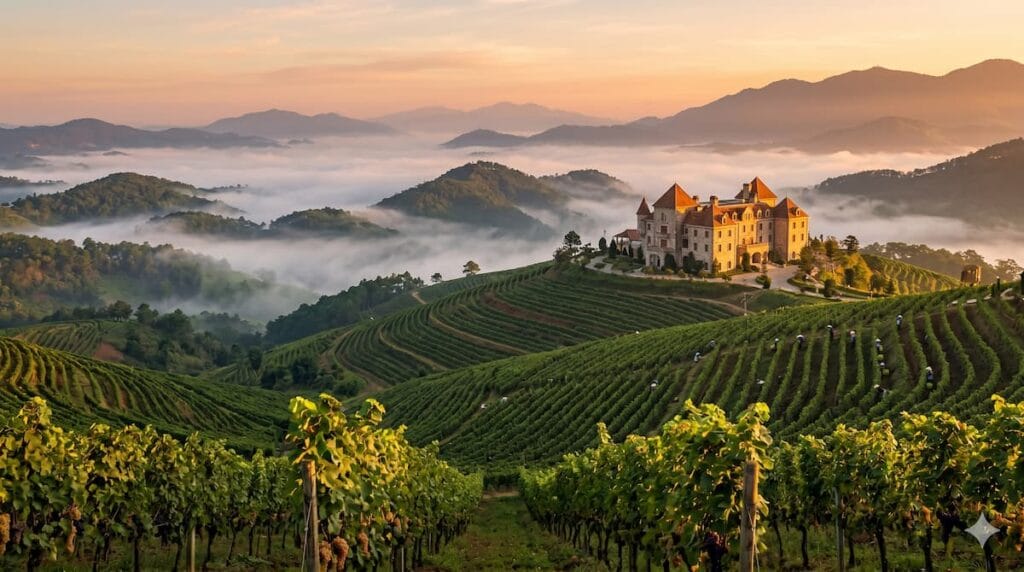
In the late 19th century, France brought many things to this land upon colonizing Vietnam. Coffee, baguettes, and Catholic churches. There were also grapevines. The place the French devoted particular attention to was Da Lat. A highland city situated 1,500 meters above sea level. Having ascended to escape the heat of Saigon, this city was cool by Vietnamese standards. With an average annual temperature of around 18 degrees Celsius, it was a place where fog settled in the mornings and evenings.
The French governors wanted to make Da Lat the Provence of Vietnam. Indeed, vegetables, strawberries, and artichokes thrived in Da Lat. Coffee plantations were also established. However, grapes were a different story. Even though it was a highland, Da Lat, located at latitude 12 degrees, struggled to meet the conditions required for grapes. There was no winter frost, nor was there enough cold to allow the vines to enter dormancy. The first attempt quietly ended in failure.
Decades have passed since then. In 1995, following the Vietnam War, unification, and the Doi Moi reforms, a second attempt began in Da Lat. This time, it was a joint venture with an Australian winemaker. They changed the question from the start. Instead of asking, “How can European grapes be grown in this climate?”, they asked, “What kind of wine can be made in this climate?”.
Why Da Lat of all places?
The ideal latitude for growing wine grapes is between 30 and 50 degrees north and south. It is a place with an average annual temperature of 10 to 20 degrees, hot summers and cold winters, where the vines can go dormant due to frost. France, Italy, Spain, Germany, Argentina, and Chile. Most wine-producing regions are located within this belt.
Vietnam is located between 8 and 23 degrees latitude. Among them, Da Lat (11.9 degrees latitude) deviates significantly from this standard, but its elevation serves as a support. The coolness created by an altitude of 1,500 meters, the relatively large diurnal temperature range, and the dryness of the dry season—it is not perfect, but it is the only option within Vietnam.
The problem lies in the number of annual harvests. In Da Lat, grapes can be harvested twice a year. Winemakers in colder regions might envy this news. However, the reality is the opposite. The more frequent the harvest, the more the sugars and complex flavors concentrated in a single grape become dispersed. The fact that harvesting twice a year is possible means, in other words, that the vines do not take a long rest. As a result, the complexity of the wine diminishes. This was the very first obstacle that Da Lat winemakers encountered.
Vietnam's only winery, Château Dalat
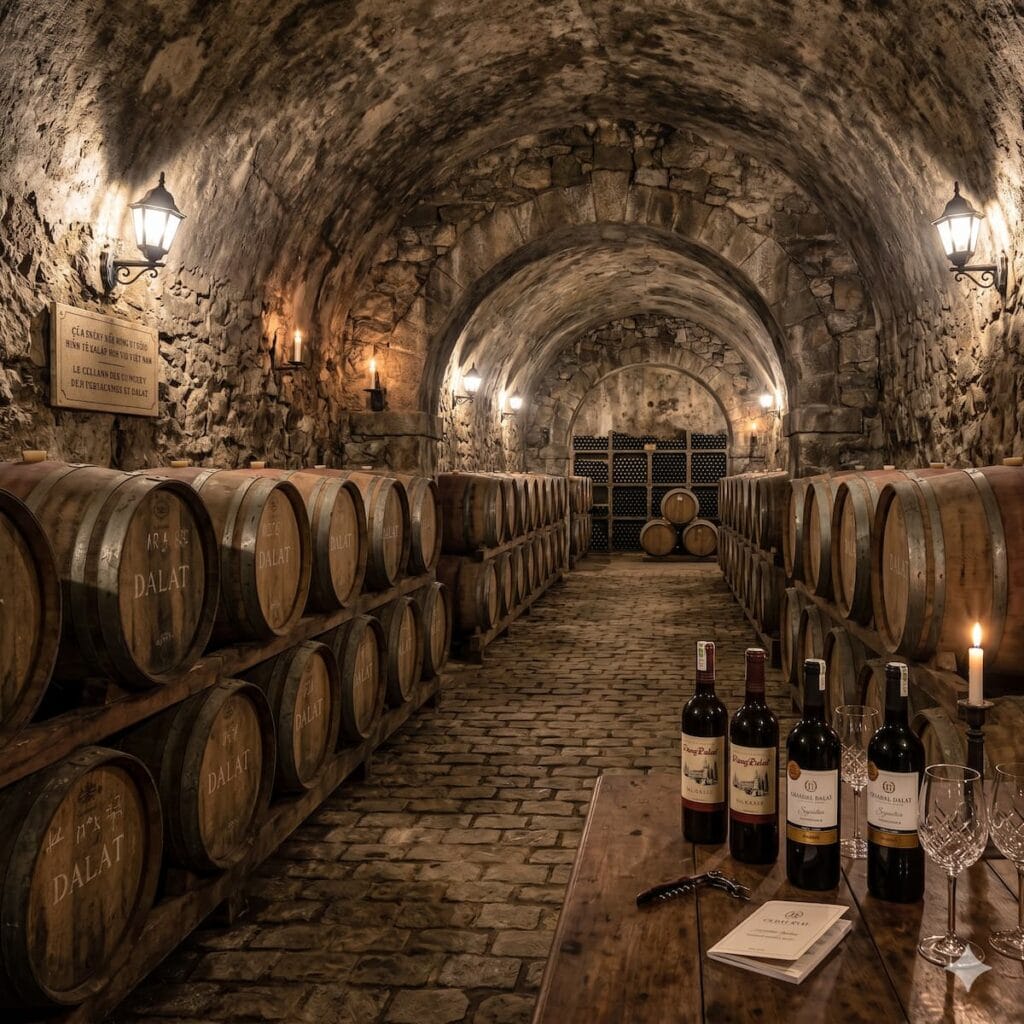
To overcome this barrier, the method chosen by the Da Lat winery was blending. They added mulberries to fill the complexity lacking from grapes alone. Mulberries, which grow abundantly in the Da Lat highlands, possess sweetness and acidity similar to grapes. By mixing Cardinal grapes with mulberries, they were able to partially overcome the climatic limitations of Da Lat.
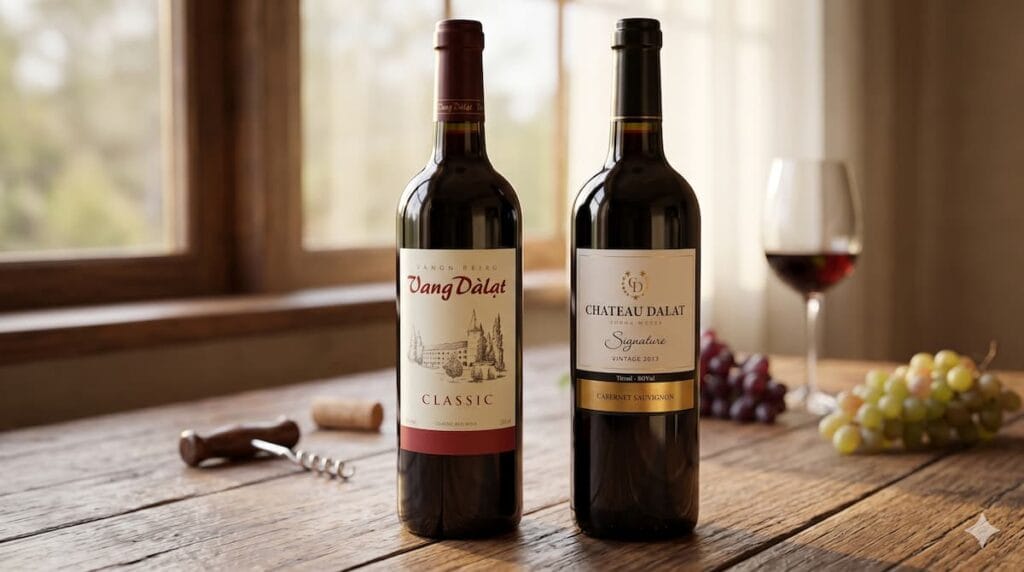
Today, the parent company of Dalat Winery is Ladora Winery. It is the only winery in Vietnam that carries out the entire process, from grape cultivation to fermentation, aging, and bottling, in one location. The Château Dalat line produced here was selected as the official wine for the APEC Summits in 2007 and 2017, and also won a gold medal at the SFIWSC (San Francisco International Wine Competition).
The product line also employs two strategies simultaneously: the Vang Dalat line, catering to Asian tastes that prefer sweeter flavors, and the Château Dalat line, a dry and complex European style. According to a local winemaker, Vang Dalat Strong generally suits Korean travelers better.
Da Lat is located in the Central Highlands of Vietnam, so you must travel to it by plane from Hanoi or Ha Long Bay. If you are planning a trip to Northern Vietnam, it is common practice to schedule your itinerary for Ha Long Bay, Hanoi, and Ninh Binh first, and consider Da Lat separately. If you need advice from a local guide while preparing for your trip to Northern Vietnam... Consult on private toursYou can contact us through [this].
How the World Views Vietnamese Wine
Vietnam ranks 59th in the world for wine consumption. Wine accounts for a mere 0.81 TP3 T in total alcohol consumption. Even this portion consists mostly of imported wines. Wines from France, Italy, and Chile fill upscale restaurants in Hanoi and Ho Chi Minh City. There is a widespread perception among consumers that imported wines are superior to locally produced ones. This is a unique irony of Vietnamese wine, where domestic wines are not properly appreciated within their own country.
Nevertheless, the market is growing. The size of the Vietnamese wine market is estimated at approximately $2 billion in 2024. There are also forecasts that it will reach $2.8 billion by 2033. The market is expanding as the growth of Vietnam's middle class, the spread of wine culture, and an increase in tourists all come together.
Evaluations on the world stage are also cautiously rising. World-renowned wine critic Jancis Robinson wrote about Vietnamese wine: “Vietnamese vines have just as much reason to exist as vines anywhere else.” While not full praise, it is a declaration that they will at least not be ignored.
For more detailed information on the export status and production scale of Vietnamese wine, Vietnam Tourism Authority Official WebsiteYou can also check it here.
If you are curious about a comprehensive guide to Ha Long Bay and Sapa, the highlights of a trip to Northern Vietnam, Northern Vietnam Travel GuideIt is also a good idea to read this first. It will help you understand the country of Vietnam in a more multidimensional way.
Wine that is not yet finished
Vietnamese wine is not a finished product. It is still being made. Tropical vineyards, climatic constraints, blending with mulberries, and gold medals at international competitions—all these stories are contained within a single glass of wine. It is interesting precisely because it is not perfect. The attempt to overcome climatic limitations through technology and creativity resembles the country of Vietnam itself.
It is not too late to make a judgment after tasting it yourself. In the next installment, based on my experience of visiting and tasting wineries in Da Lat, I will select four Vietnamese wines that suit the Korean palate.
So, which wine should you drink? I'll pick it out for you in the next episode.
If you want to hear local stories that package tours don't cover while traveling in Northern Vietnam, Inquiry about local guide toursYou can contact me. I am ready to share my experience of living in this land for 10 years.
I reside in Ha Long Bay and simultaneously work as a tour guide, operate a travel agency, and engage in local investment. For private tour consultations and travel inquiries, please use the 'Tour Inquiry' option in the top menu.