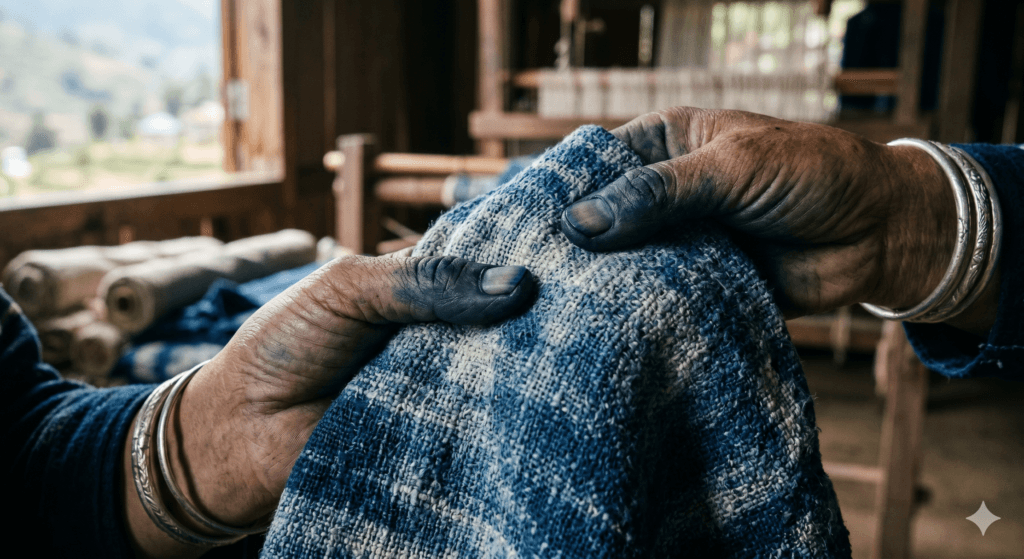
On the morning of market day, I lingered at the edge of the Sapa market. An old woman was sitting on a small wooden stool, selling something. Blue had seeped into every joint of her fingers—that color that wouldn't wash off even if she washed her hands. It was indigo. In Sapa, northern Vietnam, the surest way to identify a Hmong woman is by her hands.
First-time visitors to Sapa buy scraps of cloth sold by Hmong women in the market as souvenirs. They are pretty, exotic, and even cheap. However, every time I bought that cloth, one thing weighed on my mind: that what we are taking away is not simply blue fabric. The indigo dyeing of the Hmong people of Sapa is not a mere object, but time, a language, and, in a sense, resistance.
Having lived in Northern Vietnam for ten years, I have visited Sapa dozens of times. At first, I took in the scenery like a tourist; then, I guided the way as a local guide; and now, on that path, I have come to have a question. How much time does it take for a single piece of cloth, hand-dyed by a Hmong woman, to be completed? That question is the reason I am writing this today.
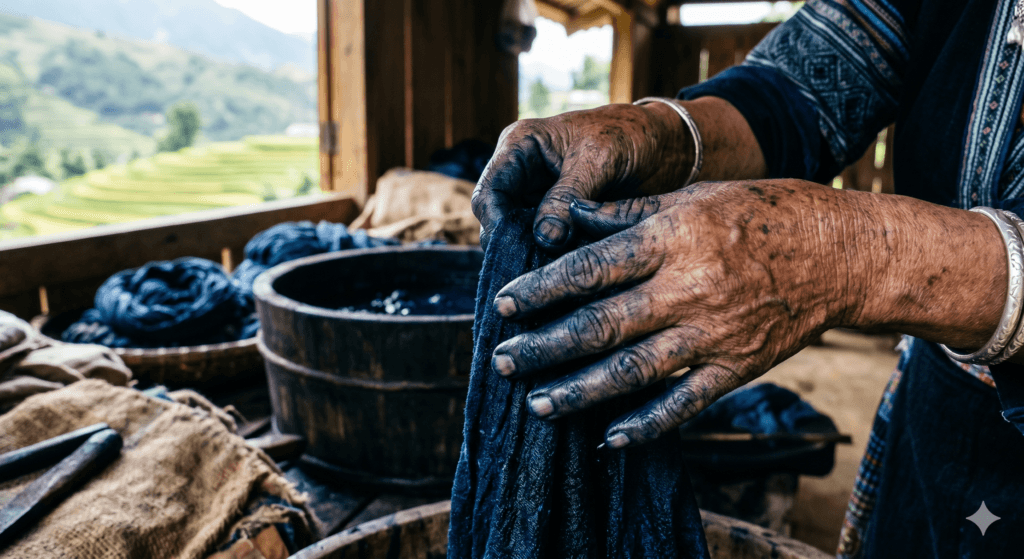
Indigo is not a color, it is a calendar.
Among the Hmong people, indigo dyeing begins with the spring. In March, they plant indigo plants in their yards. They grow the leaves throughout the summer, harvest them between August and September, and place them in fermentation jars. If the fermentation period is insufficient, the color does not develop properly. From that point on, there is no room to rush.
There are no machines in the fabric-making process either. Hemp or cotton fabric is woven by hand. The fabric is dipped in and taken out of an indigo solution dozens of times. Drying time is required after each dipping. It takes at least two weeks, and if a deep color is desired, it can take over a month. And when the wax-painting technique, in which patterns are drawn with a brush using melted beeswax, is added, the time invested in a single piece of fabric easily exceeds two months.
There is a piece of cloth sold in the market for 30,000 dong (about 1,500 won). It is highly unlikely to be the traditional indigo fabric of the Sapa Hmong people. It is either a counterfeit made with synthetic dyes from China or a product from a mass-production factory. And the Hmong grandmother herself knows this fact well. The real thing is too expensive to sell, and even if the fakes sell, there is no profit left. In the midst of this, tradition quietly disappears.
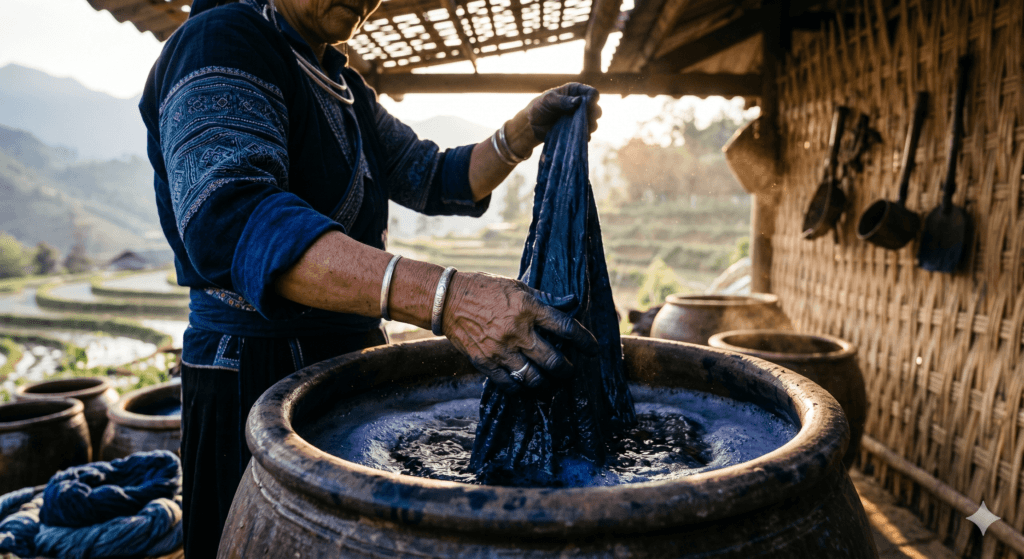
What Sapa Hmong women put in cloth
In Hmong culture, a woman's ability to make indigo cloth is not merely a skill. It is a form of qualification and a status within the community. Before marriage, daughters learn dyeing from their mothers. When they get married, they bring the cloth they made themselves. The quality of the cloth also serves as a measure of a woman's diligence and craftsmanship.
The patterns used by the Hmong people vary slightly from region to region and clan to clan. Floral motifs, geometric lines, and animal figures—while they appear to be mere decorations on the surface—these patterns embody a history and origins that are difficult to record in the Hmong language. Some anthropologists describe these fabric patterns as a form of 'text'—a script woven rather than written.
For this reason, the Vietnamese government's policies to preserve ethnic minority cultures and UNESCO's discussions regarding intangible cultural heritage are ongoing. This is because indigo dyeing is not merely a craft, but a living culture connected to the social structure of the Hmong people of Sapa. In fact Vietnam Tourism BoardIt is also introducing Hmong traditional textiles as a key resource for cultural tourism in Northern Vietnam.
The problem is that the pace of commercialization is too fast. As Sapa became famous, the market changed to suit the tastes of tourists—becoming brighter, more colorful, and selling faster. Instead of the deep, calm indigo characteristic of traditional Hmong indigo, fluorescent blue is now rampant. This is one of the reasons why the skills preserved by grandmothers for 50 years are not being passed down to the younger generation.
If you enter the villages on the outskirts of Sapa via a private tour, you can view this situation from a different perspective. There are moments when you see real indigo jars in a front yard, rather than in a tourist market. That experience lingers longer in your memory than any souvenir. If you consider visiting such villages while planning your Sapa itinerary... Kakao ChannelPlease contact us first. We will guide you on which villages are currently available to visit, access methods, and precautions.
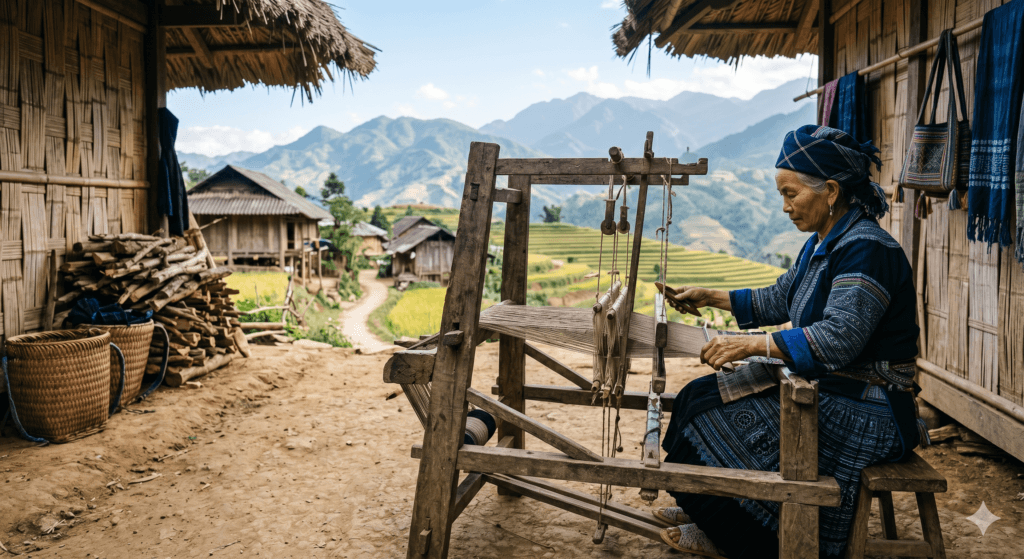
A village that the tourism market does not show
There are villages located between 30 minutes and an hour's drive from downtown Sapa that are rarely accessed by tourist buses. These include places like Ta Phin, Ban Ho, and Ta Van. Because the Hmong, Dao, Giay, and other ethnic minorities live together in these villages, the dyeing methods and patterns vary slightly. Although they are all part of the Sapa region, completely different textile cultures coexist in each village.
The story of the ethnic minorities of SapaAs I mentioned in a previous post, the way you enter a village is important. Entering without permission, or thrusting a camera at someone even after getting permission, can lead to misunderstandings among the locals. The villagers are not tourist attractions; they are simply the people who live there.
The Red Dao people live together in Taphan village. They feature colors and embroidery patterns distinct from the indigo of the Hmong people. Connecting these villages via the Sapa trekking route transforms a simple trek into a journey exploring textile culture. For trekking information by village route, Sapa Trekking GuideIt was covered in detail in [location].
When I see grandmothers sitting and weaving cloth in the village, one thought comes to mind: they are not sitting there for the sake of tourists. They are simply doing what they usually do. That scene of everyday life leaves a deeper impression than any tourist attraction.
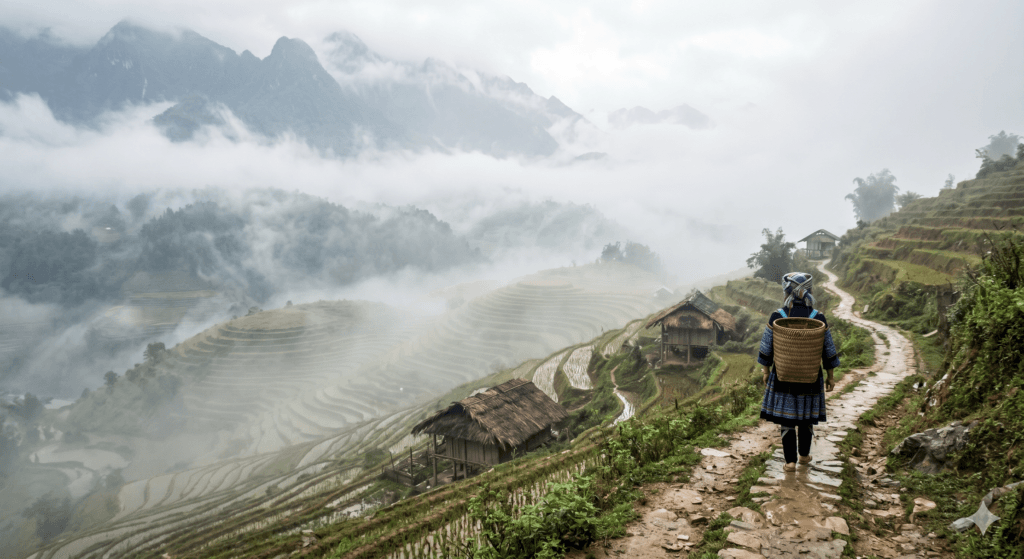
Things You Need to Know Before Buying a Sheet of Fabric
If you want to buy Hmong cloth as a souvenir during your trip to Sapa, there are a few criteria to distinguish genuine products.
First is the color. Traditional indigo dyeing is deep and uneven. If you look closely, the dyeing is not perfectly even, and the color varies slightly towards the edges of the fabric. A uniform and vivid blue is likely due to synthetic dyes. A characteristic of natural indigo is that it has a slight bluish-green tint when held up to the light.
The texture of the fabric is also different. Hand-woven hemp or cotton is thick and slightly rough. Factory-produced fabric is thin and has a smooth surface. You can feel the difference the moment you touch it. Price is also an indicator. Authentic traditional indigo fabric is by no means cheap. It starts at hundreds of thousands of VND, and high-quality, artistic pieces cost even more. It is best to consider the ones sold for a few thousand VND in the market as merely souvenirs.
And most importantly—if possible, buy from the maker. Stepping into the village and buying directly from the grandmother sitting in front of her house working completely changes the meaning of a souvenir. That fabric holds more than just color; it holds the seasons she has lived through.
If you wish to visit the Hmong village in Sapa and experience authentic traditional indigo fabric, standard package tours are insufficient. You need a guide who can plan a route tailored to your personal schedule and make proper local arrangements. Schedule coordination and consultation regarding village visits are Kakao ChannelPlease contact us.
Next episode preview
Part 8 of the Sapa series covers the most common mistakes made by first-time visitors to Hmong villages. It addresses which village to visit, how to ask for local permission, photography etiquette, and how to behave when traveling with children—topics not found in tourist guidebooks.
I reside in Ha Long Bay and simultaneously work as a tour guide, operate a travel agency, and make local investments. For private tour consultations and travel inquiries, please refer to the ' in the top menu‘Tour Inquiry‘Please use '.