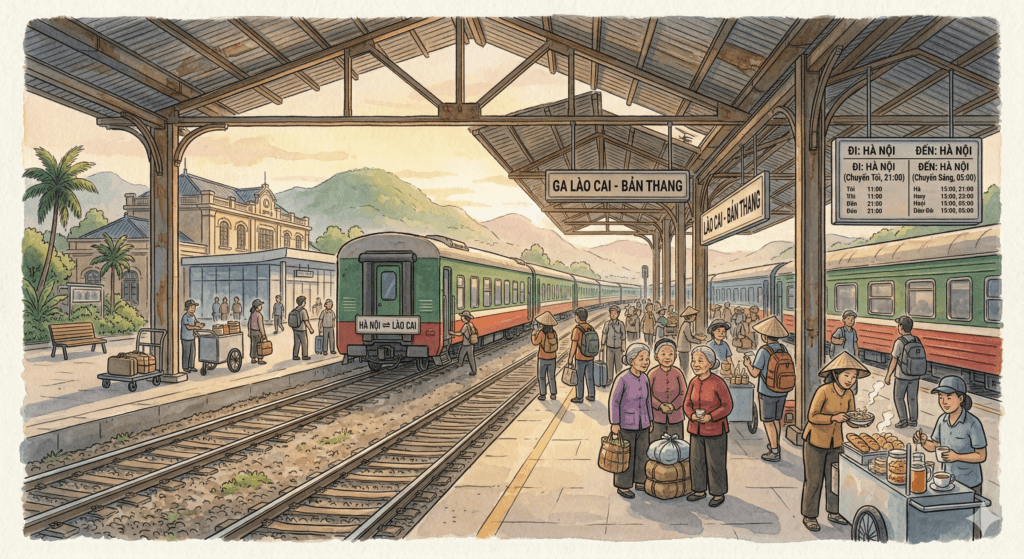
At five o'clock in the morning, the train that left Hanoi slowly comes to a stop at Lao Cai Station.
Few people come to this city for the purpose of traveling to Lao Cai. From the moment you step off the platform, sounds can be heard from all directions.
“Sapa? Sapa?” Drivers shout, and travelers check numbers to find their pickup vehicles. For some, this city is just a transit point—a place to get off briefly and then get back on the car.
I stopped at this station more than ten times. Each time, I never took the train immediately.
Things you can only experience on a trip to Lao Cai
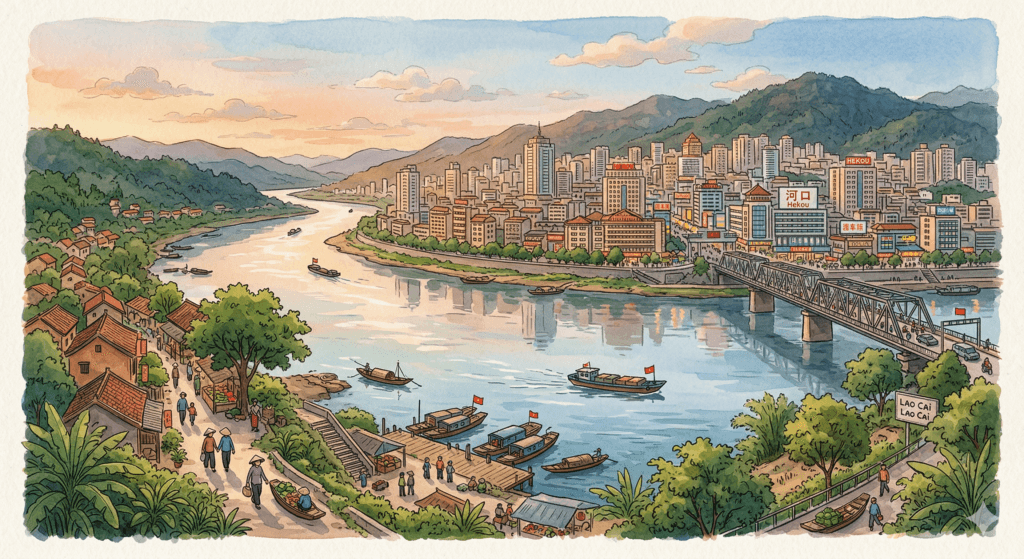
The Red River runs through this city.
What is visible across the river is Hekou, China. The distance is barely a few hundred meters. Beyond the low roofs and narrow alleys of Vietnam, the high-rise apartments and neon signs of the Chinese city stand vividly. Under the same sky, the two countries stand side by side. Such a scene is rare.
Standing on the border bridge, it feels even more direct. The Vietnamese flag flutters on one side of the bridge, while the Chinese flag flutters on the other. To the people who cross the bridge every day—merchants, laborers, and porters—the border is not a grand concept, but simply a route to and from work.
It becomes even clearer when you visit the market. Yuan and Vietnamese Dong circulate together, and it is impossible to distinguish where the goods on the stalls originated. Merchants alternate between Chinese and Vietnamese. Language, goods, and money all transcend boundaries. Lao Cai is not a place where boundaries disappear, but rather a place where they are most clearly visible.
Night market and riverside promenade
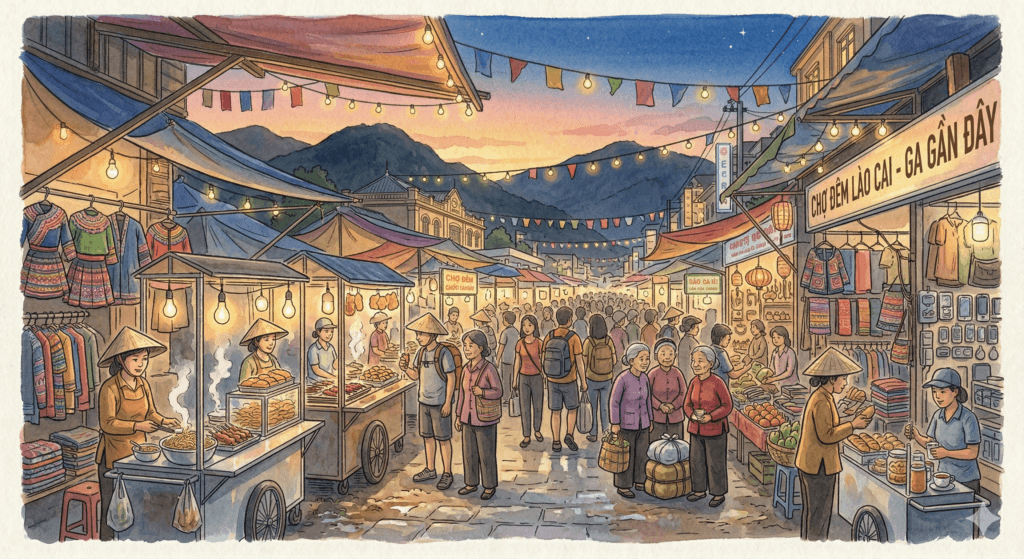
When the sun sets, a night market opens near the station.
Embroidered goods brought by ethnic minority women, household items imported from China, and Vietnamese street food line up in a row. This is not a market set up for tourists; it is where the people of Lao Cai actually come to shop. Just by looking around, you can see how this city operates.
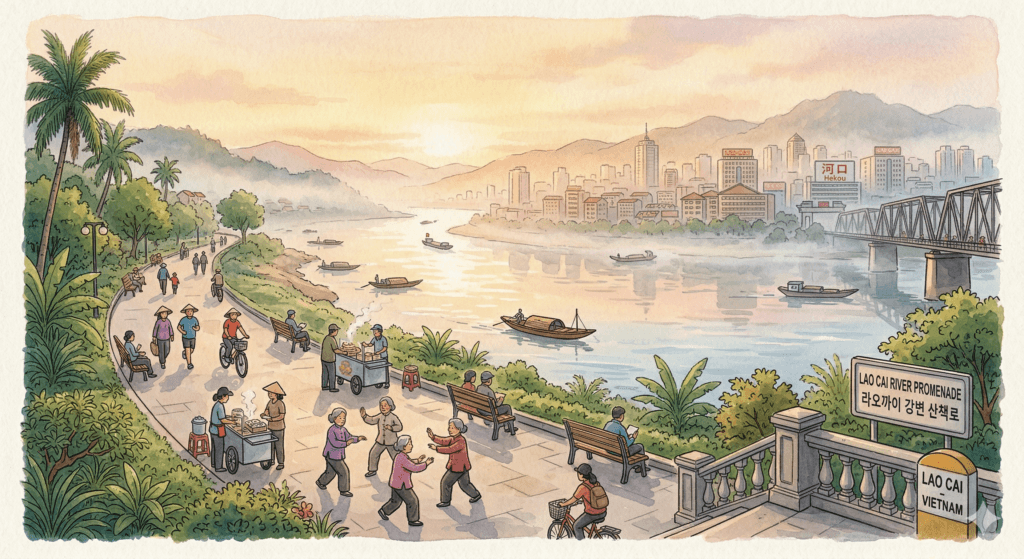
The Red River promenade is perfect for an early morning walk. Watching the river flow from China into Vietnam, one is struck by the thought that water knows no borders. While the lights on the Chinese side across the river are fading, a new day begins here. If you have arrived in Lao Cai on an early morning train, I recommend taking an hour-long walk along this trail before rushing to Sapa.
When is the best time to travel to Lao Cai?
When tailoring an itinerary to Sapa, people often do not consider the season separately. This is because they think of Lao Cai as just a place to pass through anyway.
However, having lived in this area for 10 years, I have come to realize that this city has a completely different look with every season.
Spring (March–April) It is the season when peach and plum blossoms bloom along the mountain road leading from Lao Cai to Sapa. The city center of Lao Cai is pleasant and not hot. It is also the peak season when the largest number of Korean travelers flock to the area. Although the night market is bustling, the vibrancy itself is a sight to behold.
Summer (May–August) It is the rainy season. Rain is frequent, and the water level of the Red River is rising noticeably. Standing by the riverbank, the current appears fast and the river wide. The scenery of Hekou across the river looks even more dreamlike in the rain. Since it is a season with fewer travelers, the night market feels rather relaxed, and the atmosphere is more authentic and full of human warmth.
Autumn (September–November) This is my favorite season. Clear and dry weather prevails. In October, the terraced rice fields along the mountain road leading from Lao Cai to Sapa turn golden. If you pass through Lao Cai during this time, I recommend taking your time and spending an hour by the river in the morning. You won't regret it.
Winter (December–February) It has the fewest people. Although downtown Lao Cai is chilly, it rarely snows like in Sapa. Fog is frequent, and the hazy view of Hekou across the river, obscured by the mist, strangely suits the atmosphere of this border city.
Train timetable from Hanoi to Lao Cai
From Lao Cai to Sapa — How to Get There
At Lao Cai Station SapaIt takes about 1 hour and 30 minutes by car to get there.
Taking a shared minibus costs around 40,000 to 60,000 VND, and you can catch one right in front of the station immediately after the train arrives. Private vehicles can be negotiated for around 300,000 to 400,000 VND, but since touting is intense immediately after an early morning arrival, it is best not to rush and to confirm the price beforehand. If you wish to stay overnight in Lao Cai, a guesthouse near the station is practical. If your itinerary involves returning by train after trekking in Sapa, it is convenient to stay in Lao Cai the day before your return trip.
💡 If you are confused about transportation or planning your Sapa itinerary, I can personally assist you. 👉 Inquiries regarding private tours to Sapa and Lao Cai
What Lao Cai Leaves Behind
I just passed through this city for a while.
After getting off the train, I would take a pickup car, and by the time I arrived in Sapa, Lao Cai was already forgotten. I passed by it several times like that. One day, due to a train delay, I ended up spending two hours near the station in the early morning. I walked through the night market alone and sat by the river, gazing at the lights toward China.
That was the beginning. Since then, I don't just pass through this city.
Some places remain in your memory even if they aren't your destination. Lao Cai is one such place. Standing on the border between two countries, you encounter scenery unlike anything you can see anywhere else. Isn't that what travel is all about? Experiencing the unplanned in a place that wasn't planned.
A trip to Lao Cai is the blank space on the way to Sapa. You don't have to just skip over that blank space.
If you want to properly experience Lao Cai with a local guide, which package tours often just pass by: 👉 Consult on local guide tours
💡 Next Episode Preview In the next episode, we finally arrive in Sapa. Leaving Lao Cai behind The moment of climbing the winding mountain road — Sapa writes about how he appears to people he sees for the first time.
✍️ About the Author I reside in Ha Long Bay and simultaneously work as a tour guide, operate a travel agency, and engage in local investment. For private tour consultations and travel inquiries, please use the 'Tour Inquiry' option in the top menu.