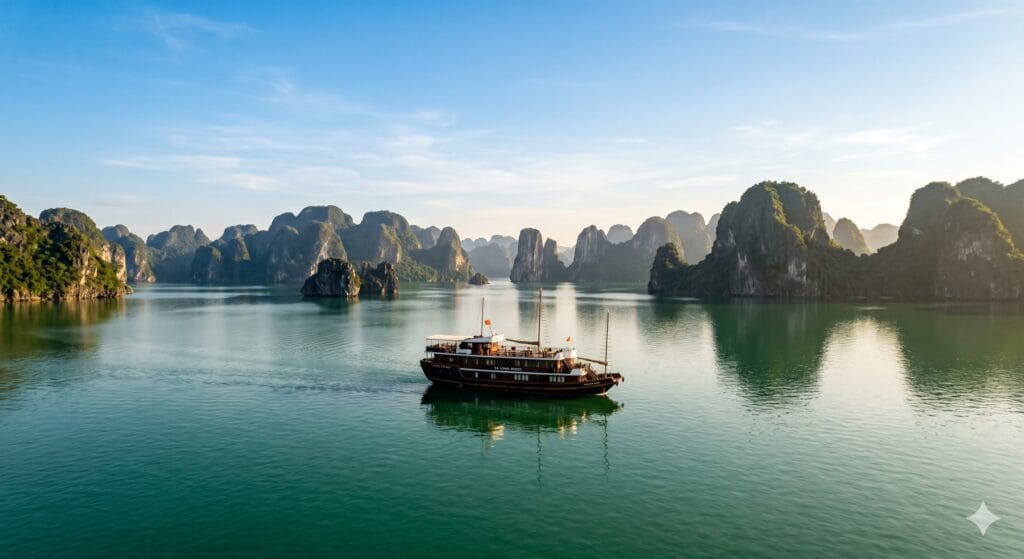
After living in Ha Long Bay for 10 years, one thing becomes clear: even though it is the same sea, Ha Long in April feels like a completely different place from Ha Long in July to Ha Long in January. On the hundreds of cruises I have personally accompanied, the most common regret I heard from guests was, "I wish I had known in advance why this time of year was chosen." Ultimately, the timing of a Ha Long Bay cruise is not merely a matter of itinerary; it is the very decision that determines the satisfaction of the trip.
What you will see out at sea that day, how long you will have to wait in line in front of the cave, and how much more you have to pay for the same cabin—all of this depends on the timing. It is essentially decided on the calendar before you even board the plane in Korea.
This article is a record summarizing the true appearance of the off-season and peak season from the perspective of a local guide who has spent all four seasons—spring, summer, autumn, and winter—at sea.
Halong Bay Cruises: Why Is 'Timing' Important?
The reason timing is crucial for a Ha Long Bay cruise is simple: the weather determines both the scenery and safety. Even when navigating the same route, the karst islands on a clear day offer a completely different experience compared to those shrouded in fog. When safety regulations are added to this, a trip chosen at the wrong time could end without even setting sail.
Ha Long Bay receives approximately 2,000 mm of annual rainfall, which is concentrated during the rainy season from May to October. According to data from the Vietnam Meteorological and Atmospheric Bureau (NCHMF), there are quite a few years where more than 350 mm of rain falls in August alone. During this period, sudden downpours and strong winds are likely to occur simultaneously.
Another crucial variable is wind speed. The Ha Long Bay Port Authority issues a departure restriction when wind speeds exceed 10 meters per second. In other words, if the Port Authority issues a restriction order on the morning of the scheduled cruise day, the entire itinerary is canceled or changed to a shortened course that only circles the vicinity of the port. How the timing is chosen determines the possibility of the departure itself.
When is the peak season for Ha Long Bay?
The peak season in Ha Long Bay is largely divided into two periods: the spring peak season from March to May, and the autumn peak season from September to October. These two periods are the times of the year when the most stable scenery and the highest prices are simultaneously found.
Spring (March to May) is ideal for outdoor activities with average temperatures between 20 and 28°C, and clear visibility is available due to minimal clouds. By mid-April, the sea has settled into a deep emerald hue, making it the season that photographers are most satisfied with. However, the fact that it coincides exactly with Korea's Golden Week holiday in May is a decisive factor.
Autumn (September to October) is the best time of year for scenic stability. As the rainy season ends and the air calms, there are frequent days when the sea surface is as calm as a mirror. The problem is that this coincides precisely with the Chuseok holiday, and recently, it has become increasingly frequent to be within the influence zone of typhoons.
The difference is clear when looking at the figures. Based on tours operated directly, weekend cruise cabin prices in April and May rise by an average of 15 to 251 TP3T compared to weekdays. The most popular 5-star 2-day, 1-night cruise on the Lan Ha Bay course goes up to the $350–$420 range per person during the Golden Week in April, while the same cabin is booked in the $240–$270 range on weekdays in November.
While the peak season has the advantage of offering the most stable scenery, it also means long queues at popular caves (Tien Cung, Sung Sot) and a limited selection of rooms. Therefore, booking at least 4 to 6 weeks in advance is practically essential if you plan to visit during the peak season.

When is the off-season for Ha Long Bay?
The off-season is also divided into two periods: the summer off-season (June to August) and the winter off-season (November to February). Since the nature of these periods is completely different, they should not be grouped together.
While summer (June to August) superficially appears to be the vacation season, it is actually the most challenging time in Ha Long Bay. As it is the middle of the rainy season, there is a daily possibility of a downpour, and it is not uncommon for the area to fall within the typhoon zone around August. This is also the period when the departure restriction standard of 10 meters per second is triggered most frequently. On average, about one in five trips I personally accompanied during July and August were either switched to a shortened course or had the first day's itinerary reduced.
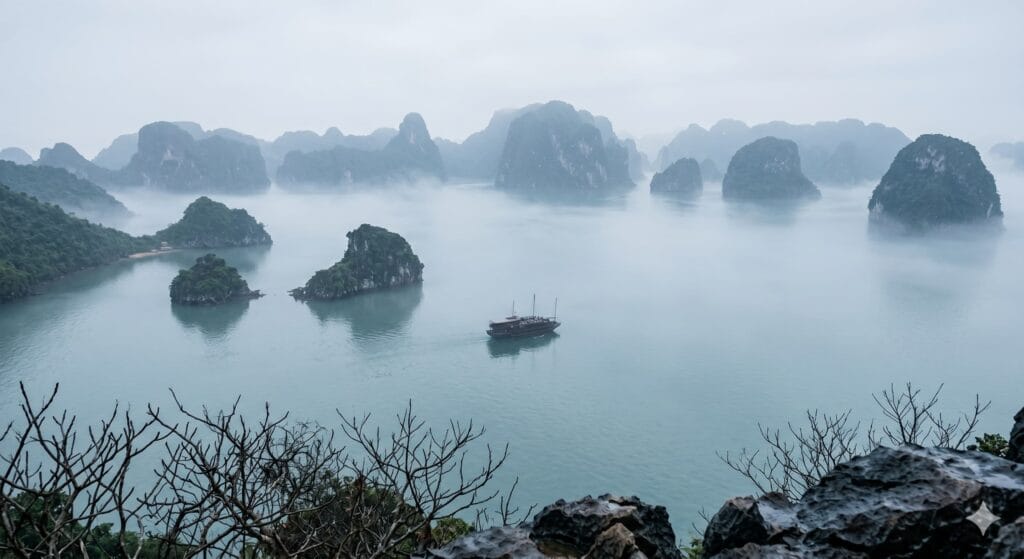
The atmosphere is different in winter (December to February). The average temperature is 15–18°C, similar to late autumn in Korea. However, the dense fog characteristic of Ha Long Bay occurs frequently; according to data from the Vietnam Meteorological Agency, it is common for the number of foggy days to exceed 10 per month on average. The foggy karst landscape may look like a traditional ink painting, but it can feel stifling if your purpose is photography.
Even during the off-season, there are clear strengths. Prices are 20 to 301 TP3T cheaper compared to the peak season, and caves and kayak spots become less crowded. This is why guests who prefer a quiet sailing experience with their families surprisingly choose winter.
Peak Season vs. Off-Season — How Different Is It Actually?
The most frequently asked questions ultimately boil down to one: “So, how different are the two periods actually?” The differences become clear when organized along four axes.
First is the weather and visibility. During the peak season, clear skies and expansive karst landscapes are practically guaranteed. If you take photos of the sky from mid-April to early May, a uniform shade of blue covers the sky. The off-season, however, presents many variables. Summer brings sudden downpours, while winter brings dense fog. Even if you take the same photo from the same location, the results can be completely different.
Second is the cruise price. Based on the same ship and cabin, prices are approximately 20 to 301 TP3T cheaper during the off-season compared to the peak season. The average price for a 5-star 1-night, 2-day stay, verified directly through our network, was $270 on weekdays during the peak season and $195 on weekdays during the off-season. This difference applies equally to dining options and additional costs for kayaking, not just cabin rates.
Third is the density of tourists. On weekends during peak season, long lines form from the entrance of Tien Cong Cave. In the tours I personally operated, there were several instances where we could not stay in a single cave for more than 30 minutes. During the off-season, however, you can leisurely take photos in the same cave and listen to the guide's explanation until the end.
Fourth is operational stability. There are almost no cancellations of departures during the spring and autumn peak seasons. On the other hand, from June to August and in September, the likelihood of switching to shortened routes due to typhoons and strong winds is highest. In winter, departure delays due to fog occur occasionally, but it is rare for it to escalate to full-scale suspension. In terms of safety alone, the peak season is overwhelmingly more advantageous.
Having accompanied them personally for several years, I have clearly felt that when the same guests take the same course over two seasons, their evaluations differ. One person is left with the photos of a lifetime, while the other is left with the regret of a shortened itinerary.
What is the right time for my travel style?
The choice of timing is ultimately a matter of “what to prioritize.” There is no single right answer that suits everyone, and the answer varies depending on priorities.
For travelers whose primary goal is photography, the spring peak season (April to May) is the safest choice. From mid-April to early May, average cloud cover is at its lowest and visibility is excellent, bringing the three-dimensional quality of the karst landscape to life. While there is the downside of it coinciding with long holiday weekends, it is well worth it if your goal is the quality of your photos.
If price is your priority, I recommend the winter off-season (November to early December). The rainy season has completely ended, and it is still a while before the fog occurs every day. You can book the same room for around 251 TP3T cheaper than during the peak season, and there is almost no wind speed control.
If you want a quiet atmosphere, the weekday off-season is the way to go. Weekdays in January are so peaceful that popular caves are practically empty. On a Tuesday in January that I personally managed, there was even a time when our group was the only one inside Tien Cung Cave.
If you want to avoid Korean holidays, the key is to adjust your schedule for the one to two weeks before and after the Chuseok holiday in September. The scenery is the same during the week right before the holiday and on the weekdays immediately following, but the prices and crowds are gone. This is the most cost-effective timeframe.
What Matters More Than Timing — Cruise Selection and Schedule
Once you have decided on the timing, the next step branches into two: whether to go for a traditional 2-day, 1-night cruise or to opt for a day tour. In fact, for many guests, this decision determines their satisfaction more than the choice of timing itself.
A 2-day, 1-night trip allows you to experience all the unique moments of Ha Long Bay, such as sunsets on board, morning fog, and dining on deck. However, it comes with the burden of cost and scheduling. A day tour drops the cost to less than half and has a lighter itinerary, but you miss out on the night scenery, which is the true charm of Ha Long Bay. Regardless of the season, this choice changes the tone of the entire trip.
For a more detailed comparison The Complete Guide to Ha Long Bay CruisesI have organized it here. If an overnight trip is too much of a burden... Halong Bay Day Cruise Tour ComparisonIt is also good to refer to this.
If you have set a timeframe but are at a loss for scheduling, a 10-year residency guide will provide direct consultation.
👉 Consult on Tour Itinerary
Ultimately, timing changes the quality of experience.
No matter when you go, Ha Long Bay is Ha Long Bay. Neither the shape of the karst islands nor the depth of the sea changes. However, the season determines what kind of light and air will be clothed upon that landscape. Even when navigating the same route from the same location, the blue vistas of April, the misty rain of August, and the ink-wash-like scenery of January leave completely different memories.
There are alternatives for travelers who find an overnight trip too burdensome. In the next post, we will compare Halong Bay day cruise tour options in detail. Before that, if you would like to get a better grasp of the big picture... The Complete Guide to Ha Long Bay CruisesYou can check the overall flow in.
If you want a Halong Bay itinerary you planned yourself rather than a package tour:
👉 Consult on local guide tours
External reference: UNESCO World Heritage Site — Ha Long Bay
The author resides in Ha Long Bay and works as a tour guide, operates a travel agency, and engages in local investment. For private tour consultations and travel inquiries, please use the 'Tour Inquiry' option in the top menu.